
 By Editor Team
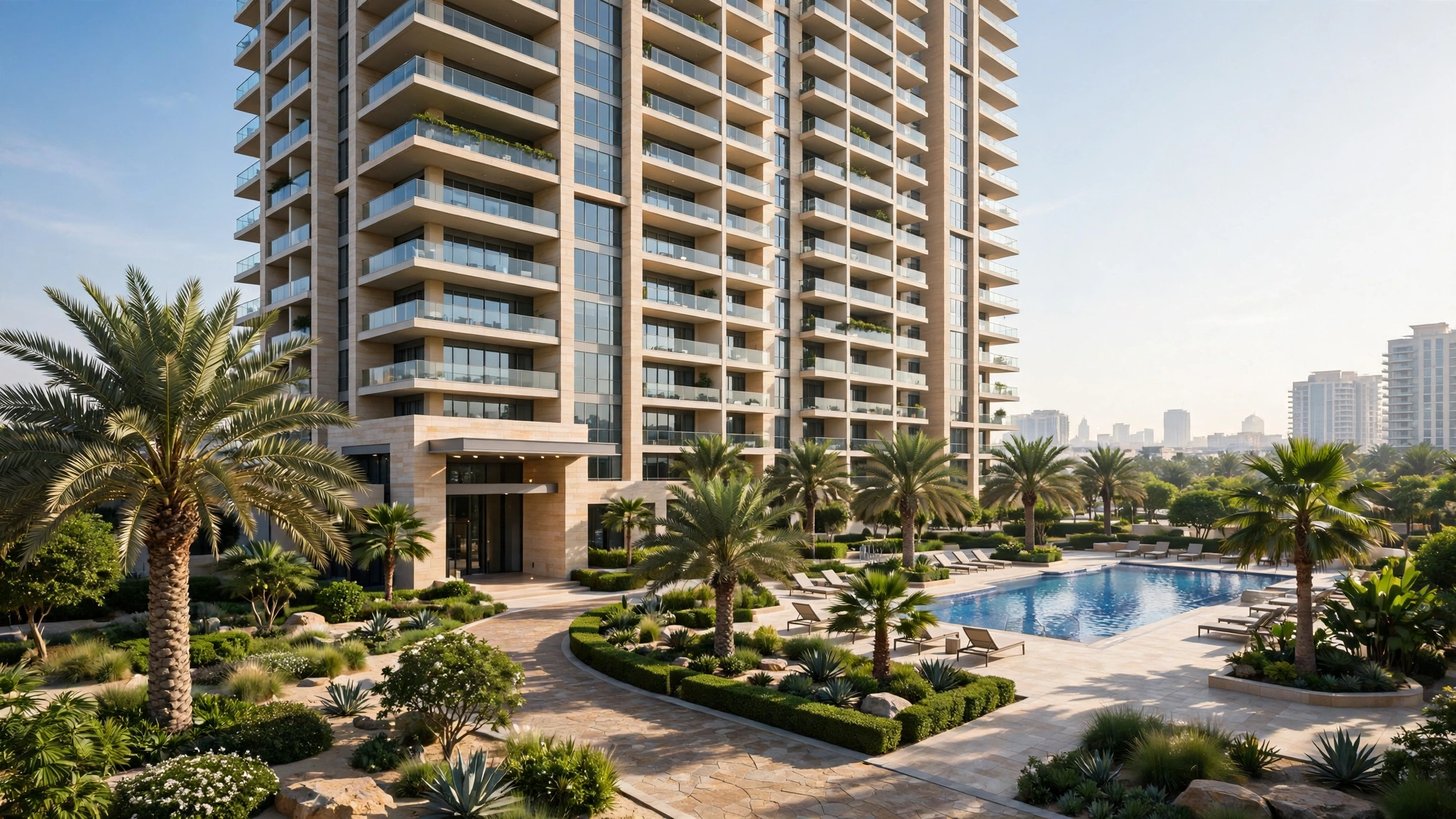
Buy the flat and the purchase price is only the start. Every owner in a Dubai freehold building or community also pays an annual service charge, the one running cost that catches new buyers out. On a typical one bedroom it runs from about AED 6,000 a year in a budget community to well over AED 25,000 in a prime tower, and if you let the place out it comes straight off your rental return.
The good news is that Dubai regulates these charges tightly. Rates are approved by the regulator, published online, and free to check before you buy. This guide explains what you pay, what it covers, how Mollak approves and audits the numbers, and how to look up the exact rate for any building.
Short answer: Service charges are the yearly fees every freehold owner pays towards running the shared parts of their building or community, quoted in AED per square foot per year and multiplied by your unit’s area. Most ordinary apartment buildings charge between around AED 10 and AED 24 per sq ft, budget areas like International City sit near AED 8 to 12, and premium towers in Downtown Dubai and on the Palm run from around AED 28 to AED 35 or more. Villa communities are much cheaper, usually around AED 2 to 6 per sq ft. Every rate must be approved by RERA through the Mollak system, and you can check any project’s approved rate in the Dubai Land Department’s Service Charge Index or the Dubai REST app.
What are service charges, exactly?
A service charge is your share of the cost of running everything in the development that no single owner owns alone. The lifts, lobby, pool deck, car park and building structure all have to be cleaned, lit, insured and repaired, and the owners pay for that together.
The legal basis is Dubai Law No. 6 of 2019 on jointly owned property, which works out each owner’s share by area: your unit’s registered area as a ratio of the whole development. In practice the approved budget is published as a single rate in dirhams per square foot per year, so your bill is simple arithmetic, the rate times the area on your title deed.
Two things follow. The charge is based on your unit’s total built up area, not the smaller living area an agent might quote. And the owner pays, not the tenant, unless a tenancy contract passes some element on, and even then the liability lands back on the owner if the tenant does not pay. It is also separate from the one off costs of buying, covered in our guide to how much money you really need to buy property in Dubai.
Charges are usually billed quarterly, half yearly or annually, and the money must sit in a dedicated service charge account for the building, separate from the management company’s own funds.
Typical service charge rates by area
Rates vary far more by building than by district. Two towers on the same street can differ by 30 to 50 percent because one has a concierge and a huge pool deck while the other keeps things simple. Still, area averages give you a useful first filter, and the ranges below reflect approved budgets published through Mollak and the DLD Service Charge Index in recent budget years.
| Area or property type | Typical rate, AED per sq ft per year | What a 750 sq ft one bedroom pays |
|---|---|---|
| International City (apartments) | Around 8 to 12 | AED 6,000 to 9,000 |
| Jumeirah Village Circle (apartments) | Around 10 to 16 | AED 7,500 to 12,000 |
| Jumeirah Lake Towers (apartments) | Around 13 to 18 | AED 9,750 to 13,500 |
| Business Bay (apartments) | Around 14 to 24 | AED 10,500 to 18,000 |
| Dubai Marina (apartments) | Around 14 to 28 | AED 10,500 to 21,000 |
| Downtown Dubai (apartments) | Around 18 to 35 | AED 13,500 to 26,250 |
| Palm Jumeirah (apartments) | Around 20 to 40 | AED 15,000 to 30,000 |
| Villa communities (most areas) | Around 2 to 6 | Not applicable, villas are larger |
| Branded and hotel managed residences | Around 35 to 60+ | AED 26,250 and up |
Treat these as orientation, not quotes. Branded towers sit at the top because you are paying for hotel grade staffing, while older low rise buildings with few amenities can come in under AED 10 per sq ft even in decent locations. The charge also shapes which districts make financial sense: several of the cheapest freehold areas to buy property in Dubai pair low purchase prices with low service charges, a big part of why their net yields hold up so well.
What the money actually pays for
Open a service charge breakdown in the index and you will see the same budget headings again and again:
- General maintenance and repairs. Lifts, pumps, fire systems, common area lighting, plumbing and the building fabric.
- Cleaning and waste. Lobby and corridor cleaning, garbage collection and pest control for shared areas.
- Security and concierge. Guards, CCTV, access control and front desk staff where the building has them.
- Pools, gyms and landscaping. Lifeguards, pool plant, gym equipment servicing, gardeners and irrigation.
- Common area utilities. Electricity and water for shared spaces, plus the master community charge where a building sits inside a larger master development.
- Insurance. Building insurance for the structure and common parts.
- Management fee. The licensed management company’s fee for running all of the above.
- Reserve fund. Money set aside for big future items, like replacing lifts or repainting the facade, so owners are not hit with one huge bill later.
Your own DEWA bill is separate: the electricity and water inside your flat, and your internet, are never part of the service charge.
Cooling deserves its own note. In a tower with its own chiller plant, cooling generally sits inside the service charge. In a district cooling building, a provider such as Empower, Emicool or Tabreed bills the occupier directly, a fixed capacity charge plus metered consumption, on top of the service charge. That is why listings say “chiller free” when the landlord covers it. Always ask which setup a building uses before comparing rates.
Mollak: how charges are approved and audited
Mollak is the Dubai Land Department’s online system for jointly owned property, run by RERA, the regulatory arm of the DLD. Its name is Arabic for “owners”, which tells you who it exists to protect. Since Law No. 6 of 2019, no management company or developer can simply decide what to charge you. The process runs like this:
- The management company prepares an annual budget, costed by category, with tenders from service providers behind the numbers.
- A RERA recognised audit firm reviews and approves that budget.
- RERA then approves the budget through Mollak. Until that approval exists, the management entity cannot impose or collect the charge.
- Invoices are issued through Mollak, and payments go into the building’s dedicated account at a RERA recognised bank.
- The approved rate is published in the DLD Service Charge Index, where anyone can see it.
Owners are not powerless inside this system. Once at least 10 percent of a development’s units are registered to individual owners, RERA can appoint an owners committee of up to nine members, which reviews budgets, requests financial reports, receives complaints and can raise unresolved problems with RERA. If you want a voice in what your building spends, the committee is where it happens.
How to check your building’s service charges, step by step
You do not need an agent to see the approved rate. The Service Charge Index is free and public.
- Open the index. Use the Service Charge Index on the Dubai Land Department website, or open the Dubai REST app and choose it from the services list.
- Find the project. Search by the building or community’s registered name, which occasionally differs from the marketing name on a brochure, so try variations if the first search fails.
- Choose the use. Pick residential, since one project can carry different rates for residential, retail and office space.
- Choose the year. Look at the latest year first, then the year before, so you can see whether the charge is stable, creeping up or jumping.
- Read the result. You get the approved rate per square foot and a breakdown by budget heading, showing what share goes to services, utilities, management and the reserve fund.
- Do the maths. Multiply the rate by your unit’s area from the title deed. That is your expected annual bill, and it should match your Mollak invoices. Owners can also see their rate, invoices and payment history against their unit in Dubai REST.
Do this check before you buy, not after. Ask the seller for the latest statement too, because the index shows the rate, not whether the current owner is in arrears. Unpaid charges sit on the unit and must be cleared before the transfer NOC is issued, so a clear statement protects you.
How service charges affect your rental yield
Gross yield is the number in the brochure. Net yield is what reaches your bank account, and service charges are usually the biggest single deduction. Here is a small worked example.
Say you buy a 750 sq ft one bedroom in JVC for AED 800,000 and let it for AED 52,000 a year, a gross yield of 6.5 percent. At AED 13 per sq ft, the service charge bill is AED 9,750. Take that off the rent and you have AED 42,250, about 5.3 percent, before agency fees, maintenance inside the flat and empty weeks between tenants. One line item has cost you more than a full percentage point of yield.
In a prime tower charging AED 28 per sq ft, the same flat’s bill would be AED 21,000 a year, and the rent would need to be far higher just to stand still. This is the quiet reason affordable districts keep topping yield tables: when you compare areas and yields across Dubai, low service charges protect the net return in a way a slightly higher rent never quite matches. Always run your numbers from the building’s actual approved rate, not the area average.
If a charge looks wrong: disputes and your options
You have a real case in a few specific situations: the invoice exceeds what the RERA approved budget allows, money is collected for things the budget does not cover, or no approved budget stands behind the charge at all. Feeling the charge is expensive is not, on its own, a ground that gets anywhere, because RERA has already audited and approved the figure.
Work through it in order:
- Compare the invoice with the index. Pull the approved rate for your project and year and set it against your Mollak invoice. This paper check settles most arguments.
- Write to the management company. Ask, in writing, which line of the approved budget the disputed amount comes from, and request the audited budget and breakdown.
- Use the owners committee. If your building has one, ask it to take the issue up. Committees can request financial records and escalate unresolved matters to RERA.
- Complain through official channels. Complaints about a management company can be filed through the Dubai REST app, and a dispute needing a binding ruling goes to the Rental Dispute Settlement Centre, which has jurisdiction over service charge disputes under the 2019 law.
One warning matters more than the rest: keep paying while you dispute. Unpaid charges build up as arrears on your unit, and arrears block the NOC you need to sell. Winning an argument about one line item is not worth freezing your own exit.
FAQs
Who pays service charges in Dubai, the owner or the tenant?
The owner. Service charges are an owner’s obligation under Law No. 6 of 2019. A tenancy contract can pass specific items, such as district cooling consumption, to the tenant, but if the tenant does not pay, the owner remains liable.
How are Dubai service charges calculated?
The RERA approved annual budget is converted into a rate per square foot per year. Your bill is that rate multiplied by your unit’s registered area. A 750 sq ft flat in a building charging AED 14 per sq ft pays AED 10,500 a year.
What is Mollak?
Mollak is the Dubai Land Department’s online platform, run by RERA, that manages service charges for jointly owned property. Budgets are audited and approved through it, invoices are issued through it, and the approved rates feed the public Service Charge Index.
Can a management company raise service charges whenever it likes?
No. A management entity cannot impose or collect a charge without RERA approval, and the budget must first pass a RERA recognised audit firm. Some communities have also moved onto fixed multi year fees approved in advance, so check which setup your building uses.
How do I check the service charge for a building before buying?
Use the free Service Charge Index on the Dubai Land Department website or in the Dubai REST app. Select the project, the residential use and the year to see the approved rate per square foot. Then ask the seller for a recent statement to confirm there are no arrears on the unit.
Are chiller charges included in the service charge?
It depends on the building. Where a tower runs its own chiller plant, cooling generally sits inside the service charge. In district cooling buildings, providers like Empower, Emicool or Tabreed bill the occupier separately, a fixed capacity charge plus metered consumption, so your total running cost is higher than the service charge alone suggests.
Why are villa service charges so much lower per square foot?
Villas share fewer expensive systems. There are no lifts, pool decks or concierge desks to staff, and the shared costs are mainly roads, landscaping, security and community facilities spread across large plots. Most villa communities charge around AED 2 to 6 per sq ft, although premium addresses such as Palm Jumeirah villas sit higher.
What happens if I do not pay my service charges?
The debt stays attached to your unit. The management company can pursue it through the Rental Dispute Settlement Centre after due notice, and unpaid balances block the NOC needed to transfer the property, so you cannot sell until the account is cleared. Disputing a charge is not a reason to stop paying it.