
 By Editor Team
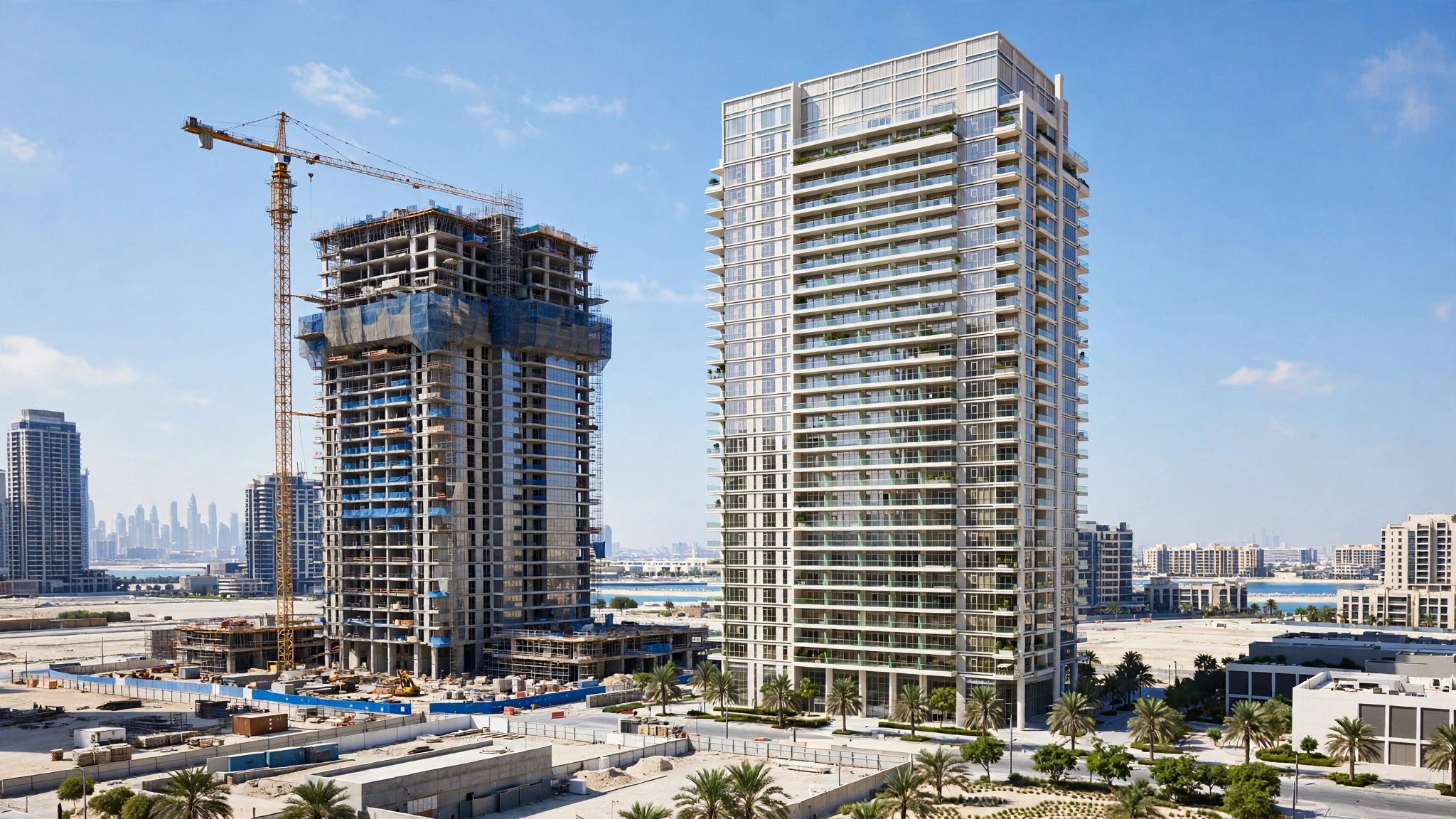
Almost every off-plan launch in Dubai leads with a pair of numbers. 60/40. 80/20. Sometimes just “1% monthly” in letters a foot high. These numbers decide how much cash you need, when you need it, and how much risk you carry while the building goes up, yet they are rarely explained in plain language. This guide walks through each plan type and what a real schedule looks like in dirhams, plus the costs that sit outside the plan, because the plan is never the whole bill.
Short answer
A Dubai off-plan payment plan splits the price into a booking payment, instalments during construction, and a balance at handover or after it. The first number is the share you pay before you get the keys, the second is the share due at handover. On a 60/40 plan you pay 60% during the build and 40% at completion. A 1% monthly plan replaces the milestone instalments with a flat 1% of the price every month. A post-handover plan pushes part of the price past the keys, so you keep paying the developer for two to five years after moving in or renting the place out. Developers do not charge interest on these plans, but easier plans are often priced higher, and the 4% DLD fee sits on top of every structure.
How every off-plan payment plan is built
Whatever the headline numbers, nearly every plan has the same three stages.
Booking. You reserve the unit and sign the sale and purchase agreement (SPA). The booking or down payment is typically 10% to 20% of the price. The 4% Dubai Land Department fee is usually collected around this point too, because the sale has to be registered early (more on fees below).
Construction instalments. You pay the rest of the pre-handover share in stages. Instalments are either construction linked, meaning each one falls due when the project passes a certified stage of completion, or time linked, meaning they fall due on fixed calendar dates in the SPA whether or not the building has kept pace. This distinction matters if the project runs late. With a construction linked plan, your payments slow down with the build. With a time linked plan, they do not.
Handover, and sometimes beyond. When the building is complete you pay the balance, receive the keys and, on a standard plan, get the title deed. On a post-handover plan the balance is split into further instalments instead.
Two protections run underneath all of this. Your purchase is registered on Oqood, the DLD’s interim register for off-plan sales, and every instalment before handover goes into the project’s escrow account, not to the developer’s own bank account. Both are explained in the risks section below.
| Plan | Paid before handover | Due at handover | Paid after handover | Usually suits |
|---|---|---|---|---|
| 80/20 | 80% | 20% | Nothing | Cash buyers who want a small final bill |
| 70/30 | 70% | 30% | Nothing | Buyers who want a middle path |
| 60/40 | 60% | 40% | Nothing | Buyers who will mortgage the balance at handover |
| 1% monthly | Booking plus 1% a month | Remainder, or nothing if the plan runs on | Sometimes | Buyers paying from monthly income |
| Post-handover | 40% to 60% | Small amount or nothing | 40% to 60% over 2 to 5 years | Investors who want rent to help cover the tail |
Exact splits vary by developer and by launch. The schedule printed in your SPA is the only version that binds you, so always read that rather than the brochure.
80/20 and 70/30: most of the money during the build
An 80/20 plan asks for 80% of the price before completion and just 20% at handover. A typical shape is 20% at booking, then instalments of 10% to 15% at construction stages until you reach 80%, with the last fifth due when the keys are ready. 70/30 works the same way with a slightly bigger final payment.
Developers like these plans because buyer money funds the construction, and they are often the cheapest way to buy the same unit. The trade off is concentration of risk. Most of your money sits in an unfinished building for two or three years, protected by the escrow rules but locked in until the building is done. The upside is real though: at handover there is no scramble, and no dependence on a bank approving a mortgage in a particular month.
60/40: the classic middle ground
The 60/40 is probably the most recognised structure in Dubai. You pay 60% across the construction period and 40% on completion. A common layout is 20% at booking, four instalments of 10% during the build, and the final 40% at handover.
That final 40% is the defining feature. Many buyers plan to cover it with a mortgage, which is usually possible because the title deed is issued at handover and banks will lend against a completed unit. Either way, the plan only works if the handover payment is genuinely funded. A bank lends against its own valuation of the finished unit, not the price you agreed years earlier, so a soft market at completion can leave a gap you have to fill in cash.
1% monthly: small, flat and easy to budget
The 1% monthly plan was popularised by Danube Properties and is now offered in some form by DAMAC, Binghatti, Sobha and others. After the booking payment, typically 10% to 20%, you pay 1% of the total price every month. On a AED 1,500,000 apartment that is AED 15,000 a month, every month, for as long as the plan runs.
Some 1% plans run for a set number of months during construction and end with a larger balance at handover. A structure you will see often is 20% at booking, 1% a month for 40 months, and the remaining 40% at handover, which is really a 60/40 plan wearing a monthly costume. Others keep the 1% running after handover until the price is paid off, which can stretch the plan to 60 or even 80 months in total.
Two things to check before you fall for the headline. First, some schedules hide larger lump sums in certain months, at construction milestones for example, so a “1% plan” can include the odd 4% or 5% month. Second, the monthly figure is fixed for years: easy to budget, but unforgiving, because it is due whether your income has a good month or a bad one.
Post-handover plans: keep paying after you have the keys
A post-handover plan deliberately leaves part of the price unpaid at completion. Typically you pay 40% to 60% during construction, take the keys, and then pay the remaining 40% to 60% in monthly or quarterly instalments over two to five years. Some plans are advertised as 60/40 where the 40 is spread over three years after handover rather than due on the day.
The appeal is obvious. You can move in, or rent the unit out and let the rent carry some or all of the remaining instalments. The cash you need at the most expensive moment of the purchase, completion, drops sharply.
The costs are less obvious. Units on long post-handover plans are often priced higher than the same unit on a standard plan, because the developer is effectively lending you the balance. The obligation does not pause if the unit sits empty between tenants. And because the price is not fully paid, the title deed is normally only issued once your final instalment clears, which limits your ability to mortgage or sell cleanly in the meantime. Treat it as a short, fixed loan from the developer, not as a discount.
Worked example: an AED 1,500,000 apartment, two ways
Numbers make this clearer. Take a one bedroom apartment priced at AED 1,500,000, with a construction period of about three years. Here is the same home on a typical 60/40 plan:
| Stage | Share | Amount |
|---|---|---|
| Booking payment | 20% | AED 300,000 |
| 4 construction instalments of 10% | 40% | AED 600,000 (AED 150,000 each) |
| Handover payment | 40% | AED 600,000 |
| Total price paid | 100% | AED 1,500,000 |
Now the same apartment on a 1% monthly plan of the common 20/40/40 shape:
| Stage | Share | Amount |
|---|---|---|
| Booking payment | 20% | AED 300,000 |
| 1% monthly for 40 months | 40% | AED 15,000 a month, AED 600,000 in total |
| Handover payment | 40% | AED 600,000 |
| Total price paid | 100% | AED 1,500,000 |
The total is identical. What changes is the rhythm. The 60/40 asks for four large cheques during the build. The 1% plan asks for forty small ones, which suits a salaried buyer but never gives you a quiet month. Both leave the same AED 600,000 question at handover, needing the same answer: savings set aside, or a mortgage arranged against the completed unit. On top of either schedule, add the fees in the next section. On this apartment the 4% DLD fee alone is AED 60,000, due near the start.
The extra costs that sit outside the plan
The payment plan only covers the price. Budget separately for these:
DLD fee, 4% of the full price. For off-plan this is charged once, when the sale is registered on Oqood, usually within the first few months. It is calculated on the full purchase price, not on what you have paid so far, and you do not pay it again at handover. On paper the fee is split between buyer and seller, but in practice the buyer normally pays all of it unless the developer is running a fee waiver promotion.
Oqood and administration fees. Registering the contract and the developer’s own admin charges typically add a few thousand dirhams at the start. Figures quoted across the market commonly land around AED 3,000 to 5,500 in total, but they vary, so ask the developer for an exact written breakdown before you sign.
Agency commission. If you buy through an agent, commission is typically 2% of the price plus VAT. On a direct purchase from the developer there is usually no commission.
At handover. Expect smaller items such as service charge payments and utility connection deposits once the unit is ready.
Our guide to how much money you really need to buy property in Dubai adds these costs up across different budgets, and it is worth reading alongside this one before you commit to a plan.
Risks and protections: what the law does and does not do
Escrow protection. Under Dubai Law No. 8 of 2007, every off-plan project must have its own escrow account at a bank accredited by the Dubai Land Department. Every instalment you pay goes into that account. The developer can only draw the money out against certified construction progress, the funds cannot be touched by the developer’s other creditors, and a portion, 5%, is held back for a year after completion as a buffer for defects. Before you pay anything, check the project and its escrow account on the DLD website or the Dubai REST app, and only ever pay into the named escrow account for that project.
Oqood registration. Your contract is entered on the interim register under Law No. 13 of 2008. That entry is your legal proof of the purchase until the title deed exists, and it is what allows an off-plan unit to be resold before completion. An off-plan sale that is not registered is not properly protected, so confirm your registration certificate arrives.
Delays. Escrow protects your money, not the calendar. Handover dates can slip, and most SPAs give the developer a grace period beyond the stated completion date. Read that clause, and do not build a plan that collapses if the keys arrive late. If RERA cancels a project outright, the escrow account is frozen and refunds go through a formal liquidation process, which is orderly but slow.
Missing a payment. This is where buyers get hurt. If you default, the developer cannot simply keep everything. The developer must notify the DLD, you are typically given a window of around 30 days to fix the default, and the law (Law No. 19 of 2017, which amended the off-plan rules) caps what the developer can retain from what you have paid, based on how complete the building is. In general terms the cap is lower when construction is at an early stage and higher, up to around 40% of the price, once the project is well advanced. Your SPA will set out late payment charges and the exact process, so read those clauses before you sign, not after a bad month.
Price and plan risk. Finally, the plan itself is a risk decision. A front loaded plan concentrates your money in an unfinished building. A back loaded plan concentrates your obligations into years when the market is hardest to predict. Neither is wrong. They just fail in different ways.
Which plan suits which buyer?
You have cash and hate surprises: 80/20 or 70/30. Most of the price is settled early, the handover bill is small, and these plans often come with the keenest prices.
You earn a strong, steady salary: 1% monthly. The flat instalment behaves like a second rent payment, predictable and easy to automate, as long as the amount is comfortably inside your monthly income.
You will need a mortgage to finish: 60/40. It gives you the construction period to prepare, and the mortgage is arranged against a completed, valued unit at handover. Just remember the bank lends on its valuation, not your purchase price.
You are an investor who wants rent to do the work: a post-handover plan, priced honestly. Compare the unit’s price against the same unit on a standard plan first. If the premium for the long plan eats the rent advantage, walk away.
You are buying at the affordable end: many of the cheapest freehold areas to buy property in Dubai are dominated by off-plan launches, and developers there compete hard on payment plans. A gentle plan on a sensibly priced unit usually beats an aggressive discount on an overpriced one.
One more consideration if residency matters to you: the investor visa routes generally look at completed property with a title deed, so an off-plan unit usually only starts counting once it is handed over and registered in your name. Our guide to Dubai’s property investor visa and the Taskeen rules explains what qualifies and when.
FAQs
What does 60/40 mean in Dubai real estate?
It means you pay 60% of the price before handover, made up of the booking payment plus construction instalments, and 40% when the property is completed and handed over. The second number is always the handover share, whatever the plan.
Is a 1% monthly plan really only 1%?
The monthly instalment is 1% of the total price, but that is not the whole plan. There is a booking payment first, typically 10% to 20%, and many schedules include larger lump sums at certain milestones or a final balance at handover. Read the full schedule in the SPA, not the advert.
Do developers charge interest on payment plans?
No. Developer payment plans in Dubai do not charge interest, and there is no bank credit check, because the developer is financing you directly. The cost of that convenience is usually in the price: units on longer or post-handover plans are often priced higher than the same unit on a front loaded plan.
When do I pay the 4% DLD fee on an off-plan purchase?
Near the start. The fee is 4% of the full purchase price and is charged when the sale is registered on Oqood, usually around the booking stage. You do not pay it again at handover, and it is not spread across the instalments.
What is an escrow account and how does it protect me?
It is a bank account opened for that specific project under Dubai Law No. 8 of 2007. All buyer payments go into it, and the developer can only withdraw funds against certified construction progress. Your money cannot be diverted to the developer’s other projects or claimed by its creditors.
What happens if I miss an instalment?
The developer must follow a legal process through the DLD rather than acting alone. You are typically given around 30 days to remedy the default after notice. If the sale is terminated, the law caps how much of your money the developer can retain, based on the construction stage, from a lower cap on an early stage project up to around 40% of the price on a well advanced one. Late payment charges in your SPA may also apply.
Can I get a mortgage to cover the handover payment?
Usually, yes. Once the unit is complete and the title deed is issued, banks will consider a mortgage on it, subject to their valuation and your eligibility. The loan is based on the bank’s valuation of the finished unit, which may be higher or lower than the price you agreed off-plan.
Does an off-plan property qualify me for an investor visa?
Generally not until it is completed. The investor visa routes are based on property you own with a title deed, so an off-plan purchase usually starts counting only after handover and registration in your name. Check the current thresholds before relying on this, because the rules are updated from time to time.
Can I sell my off-plan unit before handover?
In most cases, yes, once your purchase is registered on Oqood. Developers usually require a minimum share of the price to be paid before issuing the no objection certificate for a resale, and the incoming buyer pays a fresh 4% DLD fee. The minimum varies by developer and is stated in your SPA.
Which is better, 60/40 or 80/20?
Neither is better in the abstract. 80/20 settles most of the price early and leaves a small, safe handover bill, and it often comes at a slightly keener price. 60/40 keeps more of your cash free during construction but leaves a large payment that must be funded at completion. The better plan is the one whose handover amount you can pay without stress.