 By Mehak Ishfaq
There is no road in Dubai quite like Sheikh Zayed Road. Locals call it SZR. Visitors call it the highway lined with skyscrapers. Moreover, residents call it their commute, their address, and sometimes their whole world. The section most people mean spans roughly two kilometres. It runs between the World Trade Centre and Business Bay. On either side, towers rise in a solid wall. Underneath, the Red Line metro connects the length of the corridor.
This guide covers the whole picture. It explains where the road starts and ends. It breaks down what each stretch is actually like. Furthermore, it covers property prices, things to do, and whether living here makes practical sense. If you are scouting real estate on Sheikh Zayed Road, read on.
What Is Sheikh Zayed Road and Where Does It Run?
Sheikh Zayed Road is part of the E11 highway. It was named after the UAE’s founding president, Sheikh Zayed bin Sultan Al Nahyan. Before 1980, people knew it as Defence Road. The road starts near the Oud Metha interchange in the north. It then heads south all the way to Jebel Ali. From there, it connects to Abu Dhabi. The full E11 continues northeast to Ras Al Khaimah, covering 558 kilometres in total.
However, in real estate conversations, ‘Sheikh Zayed Road Dubai’ means something more specific. It refers to the central corridor between the World Trade Centre and Business Bay. This stretch runs through Trade Centre First, Trade Centre Second, DIFC and Emirates Towers. That Business Bay end of the road is where you find the densest towers, hotels, offices and apartments. Together, they form the skyline most people associate with modern Dubai.
The Areas Along Sheikh Zayed Road Dubai
Trade Centre First and Second
This is the original SZR address. It covers two districts on either side of the World Trade Centre roundabout. In 1979, the Dubai World Trade Centre became the first skyscraper in the area. Since then, the skyline has grown steadily upward. Notable towers include Sama Tower, Park Place, the 2020 Building and the supertall Blue Tower. Most buildings here combine offices on lower floors with serviced apartments above. As a result, it feels more corporate than community-focused compared to Business Bay further south.
DIFC and Emirates Towers
The Dubai International Financial Centre sits just off the main road. It operates as the UAE’s leading financial free zone. It has its own court system and regulatory framework. Additionally, it houses international banks, asset managers and a growing cluster of fintech firms. The Emirates Towers, two triangular skyscrapers visible from across central Dubai, stand within this zone. Rents here tend to sit at the top end of the SZR corridor. This reflects both the prestigious address and the high quality of buildings typical of the DIFC area.
Business Bay on Sheikh Zayed Road
Business Bay is where the SZR corridor opens up. The skyline extends outward from the main road into a full district built around an extension of Dubai Creek. Many of the most popular towers in Business Bay sit directly on or very close to the main road. Therefore, ‘Sheikh Zayed Road Business Bay Dubai’ appears frequently in property searches. Apartments in this zone generally offer more space. They also tend to come at more competitive rents than the Trade Centre stretch. Moreover, commute times to DIFC and Downtown Dubai remain short.
Exit 39 is a junction that most Business Bay residents learn quickly. It gives direct access into Business Bay from the main road. Several of the area’s larger residential towers sit close to this exit, so it becomes a daily reference point for navigation.
Al Safa, Al Manara and the Southern Stretch
Beyond Business Bay, the road continues through Al Safa and Al Manara. Here, the character shifts noticeably. Instead of a pure commercial corridor, you find a calmer mix of residential towers and mid-rise buildings. The Safa Interchange gives direct access to Jumeirah Beach and Kite Beach. As a result, this stretch suits residents who want an SZR address without Trade Centre-level rents.
Properties on Sheikh Zayed Road Dubai
Property searches on SZR fall into two clear groups. First, professionals looking to rent and keep their commute short to DIFC or Business Bay. Second, investors who want consistent rental demand. A smaller number of end users also buy here because they genuinely want the address.
Apartments for Rent on Sheikh Zayed Road Dubai
Most SZR towers mix offices on lower floors with serviced or standard apartments above. A furnished studio in a Trade Centre building typically rents for between AED 55,000 and AED 80,000 a year. One-bedroom apartments generally fall between AED 70,000 and AED 185,000. The exact figure depends on the corridor, the building’s age and whether the unit is serviced. Furthermore, Business Bay on SZR tends to offer slightly more competitive rents than the Trade Centre zone for the same size of unit.
The chart below compares typical one-bedroom rent ranges across the main SZR corridors in 2026.
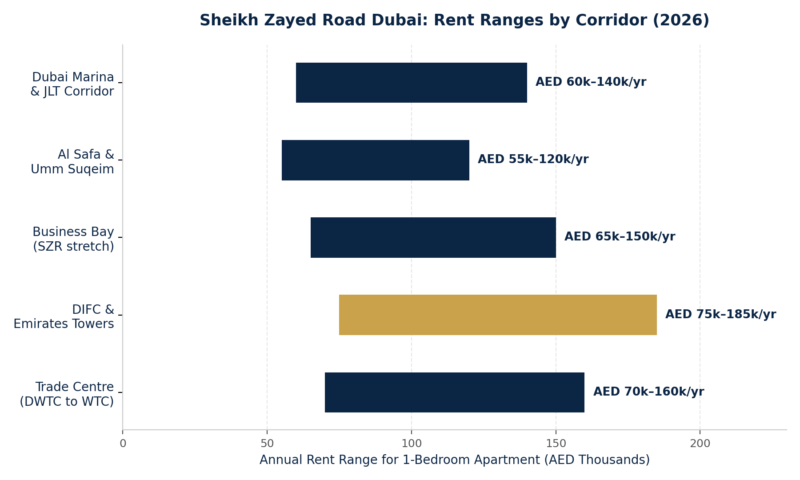
DIFC and the Emirates Towers stretch commands the highest rents. This is due to the financial centre address and the quality of the buildings. However, Business Bay on SZR and the Al Safa stretch tend to allow more room for negotiation. This is especially true in buildings that have been listed for longer than 30 days.
Apartments on Sheikh Zayed Road: What You Actually Get
| Unit | Typical Annual Rent | Notes |
| Studio | AED 55k-80k/yr | Typically furnished, suits singles |
| 1 Bedroom | AED 70k-185k/yr | Range depends on corridor and age |
| 2 Bedroom | AED 120k-260k/yr | Higher end near DIFC towers |
| 3 Bedroom | AED 180k-400k+/yr | Top-floor or penthouse units |
Properties for Sale on Sheikh Zayed Road
Freehold options directly on SZR are more limited than in newer master communities. Nevertheless, they do exist. You find them mainly in newer Business Bay developments and a handful of Trade Centre area buildings. Sale prices for a one-bedroom apartment typically start around AED 900,000 in Business Bay. They climb past AED 2.5 million for a DIFC-adjacent unit. Additionally, gross rental yields on SZR properties generally range from 5% to 7.5%, which is strong for a central address.
Things to Do on Sheikh Zayed Road Dubai
Living on SZR does not mean spending your time on a motorway. In fact, the area around the road is dense with things to do at street and tower level.
- Dubai Mall and Burj Khalifa: both reachable via the SZR metro or a short taxi ride from any point on the corridor
- Museum of the Future: the torus-shaped building just off the road has become one of Dubai’s most visited attractions since it opened in 2022
- DIFC Arts District: a cluster of galleries, restaurants and outdoor sculptures within the financial centre that most SZR residents can walk to
- Last Exit Jebel Ali South: an outdoor food truck park on the southern stretch, good for an easy evening out
- GITEX and DWTC Events: the World Trade Centre hosts some of the region’s biggest conferences year-round, with GITEX drawing the largest annual crowds
- Alif Art Gallery: a cultural venue on SZR that hosts regular exhibitions, a quieter option compared to the mall-heavy leisure nearby
What Living on Sheikh Zayed Road Dubai Is Actually Like
Many people assume SZR is just a highway with no neighbourhood feel. That assumption is only partly right. The Trade Centre stretch does feel corporate. It is busy on weekdays and quiet on weekends. Moreover, it has few parks and limited walkable retail. If you need a supermarket or green space within walking distance, this end of the road requires more planning.
Business Bay on Sheikh Zayed Road, however, sits at a different point on that scale. It is still urban and tower-heavy. Nevertheless, the canal promenade, the closeness to Downtown Dubai on foot, and the mix of residential and commercial buildings give it more of a neighbourhood feel. This is particularly noticeable at weekends. Therefore, renters who want a central address without Downtown prices often find Business Bay on SZR is the right balance.
Pros of Living on SZR
- Metro access runs along the full corridor via Red Line stations at World Trade Centre, Financial Centre, Emirates Towers and Business Bay
- Commute times to DIFC, Business Bay and Downtown Dubai are short from most SZR addresses
- Dining, hotel and entertainment options are dense within walking distance or a short taxi ride
- Serviced apartments with gym, pool and housekeeping are common across SZR buildings
Cons of Living on SZR
- Traffic is heavy on weekdays between 7am and 9am and again between 5pm and 7pm
- Green space and parks are limited along the main corridor itself
- Noise from traffic and construction affects some older buildings with older glazing
- Parking is tight in older towers and expensive in some DIFC-area buildings
What Is Changing on Sheikh Zayed Road in 2026 and Beyond
In July 2026, Dubai’s Executive Council approved a major infrastructure package. One key element is a new 15-kilometre elevated carriageway. It will run parallel to parts of Sheikh Zayed Road. The project aims to serve around 2.6 million residents. It is also designed to cut journey times by up to 51% on affected sections. Construction starts in Q3 2027 and finishes by Q4 2030. As a result, access to Al Barsha, Al Quoz, Business Bay and Meydan will improve significantly. This matters for anyone holding or considering property along the SZR corridor.
Related Reading
For buyers focused on Business Bay apartments specifically, our complete area guide to buying property in Dubai covers pricing and community details in more depth.
If you are comparing SZR against villa communities nearby, our guide to villas for sale in Dubai by budget and community covers the areas closest to the road.
Before signing with any agent on an SZR listing, our guide to real estate commission rates in Dubai explains what a licensed broker should be charging.
Verifying Properties and Ownership
Before placing any deposit on an SZR property, confirm the building’s freehold or leasehold status through the Dubai Land Department.
Frequently Asked Questions
Where exactly is Sheikh Zayed Road in Dubai?
Sheikh Zayed Road (E11) runs the full length of Dubai, from the Oud Metha interchange in the north to Jebel Ali near the Abu Dhabi border. However, in real estate terms, most people use ‘Sheikh Zayed Road Dubai’ to describe the central corridor between the World Trade Centre and Business Bay.
What is the difference between Sheikh Zayed Road and Sheikh Zayed Street?
They refer to the same road. ‘Sheikh Zayed Street’ appears in some older building addresses as an informal variation. The official name is Sheikh Zayed Road, and it forms part of the E11 highway.
Is living on Sheikh Zayed Road Dubai a good idea?
It depends on what you need. If you work in DIFC, Business Bay or Downtown Dubai, SZR gives you a short commute and strong metro access. However, if you have young children or want outdoor space and a quieter feel, communities like Al Barsha or the villa areas further from the road may suit you better.
What does Exit 39 on Sheikh Zayed Road refer to?
Exit 39 is a junction that gives direct access into Business Bay from Sheikh Zayed Road. Residents and delivery services in Business Bay use it regularly as a navigation reference.
What is the 2020 Building on Sheikh Zayed Road?
The 2020 Building is a commercial tower on the Trade Centre stretch of SZR. It takes its name from its address and serves as a registered office for many companies in the Trade Centre district.
Is Business Bay on Sheikh Zayed Road?
Yes. Business Bay sits directly adjacent to Sheikh Zayed Road on its southern end. Several towers front the road directly. Others connect via short internal roads. This is why ‘Sheikh Zayed Road Business Bay’ appears so often in property searches.
What does Dubai SZR mean?
SZR is the shorthand Dubai residents use for Sheikh Zayed Road. You will see it in property listings, navigation apps and everyday conversation. It refers to the main highway corridor running through central Dubai.
What is the new road being built alongside Sheikh Zayed Road?
In July 2026, Dubai approved a 15-kilometre elevated carriageway to run parallel to parts of Sheikh Zayed Road. It will reduce journey times by up to 51% and serve around 2.6 million residents. Construction begins in Q3 2027 and completes by Q4 2030.