
 By Mehak Ishfaq
Most people never think about UX until it fails them. You land on a property site, the search filters do not load properly, the “contact agent” button leads nowhere useful, and you close the tab without ever seeing the listing you were looking for. That entire chain of frustration is a UX problem, and in real estate it costs agencies actual leads, not just annoyed visitors.
Here is what UX actually means, why it has become such a big deal in property search specifically, and what a genuinely well built real estate website should feel like to use.
What UX Actually Means
UX stands for user experience, and at its simplest it covers how a person feels while using a website or app, from the moment they land on it to the moment they either take action or leave. It is not just how a site looks. Visual design is one part of UX, but the bigger part is whether people can actually do what they came to do without friction: search, filter, compare, contact, or book, without getting stuck or confused along the way.
For a property website specifically, UX shows up in things like how fast the search results load, whether the filters actually narrow results the way you expect, whether property photos load properly on a slow connection, and whether the “contact” or “schedule a viewing” button is easy to find when someone is ready to act.
Why UX Matters More in Real Estate Than Most Industries
Property decisions are high stakes and research heavy. Nobody rents an apartment or buys a home on impulse the way they might buy a pair of shoes, which means buyers and tenants spend real time comparing options across multiple sites before ever picking up the phone. That research heavy behavior makes UX a much bigger factor in real estate than in most other online shopping categories, since a single confusing moment is often enough to send someone straight to a competitor’s listing instead.
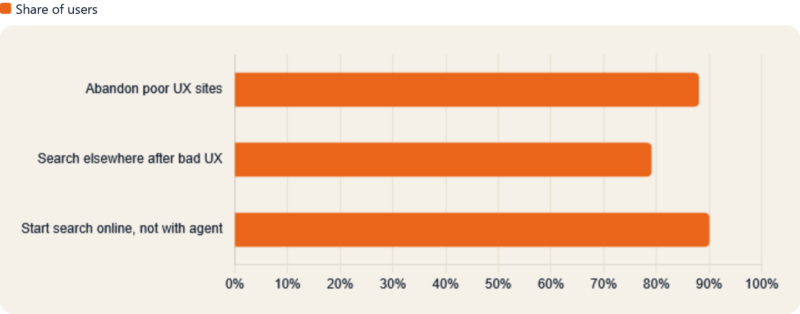
The numbers back this up. <cite index=”15-2″>Studies show that 88 percent of consumers will abandon a website if it has poor UX, and nearly four in five have admitted to searching for a different site entirely when the one they landed on did not meet their expectations</cite>. In a market like Dubai real estate, where dozens of portals and agency sites are all competing for the same searches, that abandonment rate is the difference between capturing a lead and losing one to a competitor with a smoother site.
Search behavior also plays a role. <cite index=”12-2″>Over 90 percent of buyers and tenants now start their property search online before ever speaking to an agent</cite>, which means your website is often the very first impression a potential client forms of your business, sometimes the only one.
What Good UX Looks Like on a Property Website
Fast, working search and filters.
People searching for property want to narrow results by price, location, bedrooms, and property type without the page reloading slowly or filters resetting unexpectedly. A search tool that feels sluggish or unreliable pushes visitors straight to a bigger portal instead.
Mobile friendly design
A large share of property searches now start on a phone rather than a desktop, often during a commute or a lunch break, so a site that is hard to navigate or slow to load on mobile is losing a meaningful chunk of potential leads before they even see a listing.
Clear property pages
Good listings show real photos, key facts like size and price up front, and enough neighborhood context that a buyer does not have to leave the page to figure out where the property actually sits relative to work, schools, or the metro.
Obvious next steps
Every property page should make it immediately clear how to ask a question, book a viewing, or get in touch, without forcing the visitor to dig through menus to find a contact form.
Trust signals that are easy to spot
Verified listings, clear agent details, and honest pricing information all reduce the hesitation that comes with a high value purchase or rental decision, especially for buyers researching a market from outside the country.
Common UX Mistakes That Cost Property Sites Leads
A cluttered homepage with too many competing calls to action often confuses visitors more than it helps them, since nobody is sure what to click first. Slow loading pages are just as damaging, since a large share of mobile visitors will abandon a page that takes more than a few seconds to load, well before they see a single listing. Outdated or unverified listings that do not match current market prices quickly erode trust, and a contact process that is buried several clicks deep, or that only offers a generic email address instead of a clear form or phone number, quietly pushes ready to act visitors toward a competitor instead.
What This Means If You’re Searching for Property Online
As a buyer or tenant, a well built property site should let you go from “what am I looking for” to “who do I contact” without ever feeling lost. If a site is fighting you at every step, whether that is filters that do not work, listings that will not load, or no clear way to reach someone, it is worth taking that friction as a signal and looking elsewhere rather than assuming the problem is on your end. For area specific research before you even start browsing listings, our Al Khail Heights area guide is a good example of the kind of upfront, structured information that should be easy to find on any property site before you commit to reaching out.
FAQs
What does UX mean in simple terms?
UX stands for user experience, and it covers how easy and pleasant a website is to actually use, not just how it looks visually.
Why does UX matter when buying or renting property online?
Property decisions involve significant research before contact, and a confusing or slow website often pushes buyers and tenants straight to a competitor’s site rather than getting them to reach out.
What makes a real estate website have good UX?
Fast and accurate search filters, mobile friendly design, clear property information, obvious contact options, and visible trust signals like verified listings all contribute to good UX.
How much does poor website UX actually affect a real estate business?
A large majority of users will leave a site entirely after a poor experience, which directly translates into lost leads and inquiries for agencies and property portals.
Is mobile design part of UX?
Yes. Since most property searches now start on a phone, mobile usability is one of the most important parts of real estate website UX rather than a secondary concern.
This guide is compiled by the UAEBestEstates research team, drawing on current UX research and real estate industry data. Last updated July 2026.
Looking for verified property listings backed by a site built around your search, not against it? Contact our team, or browse more Dubai real estate guides to start your search.
Are you a real estate writer or industry expert? We accept guest contributions. Write for us.
 M Asad