
 By Mehak Ishfaq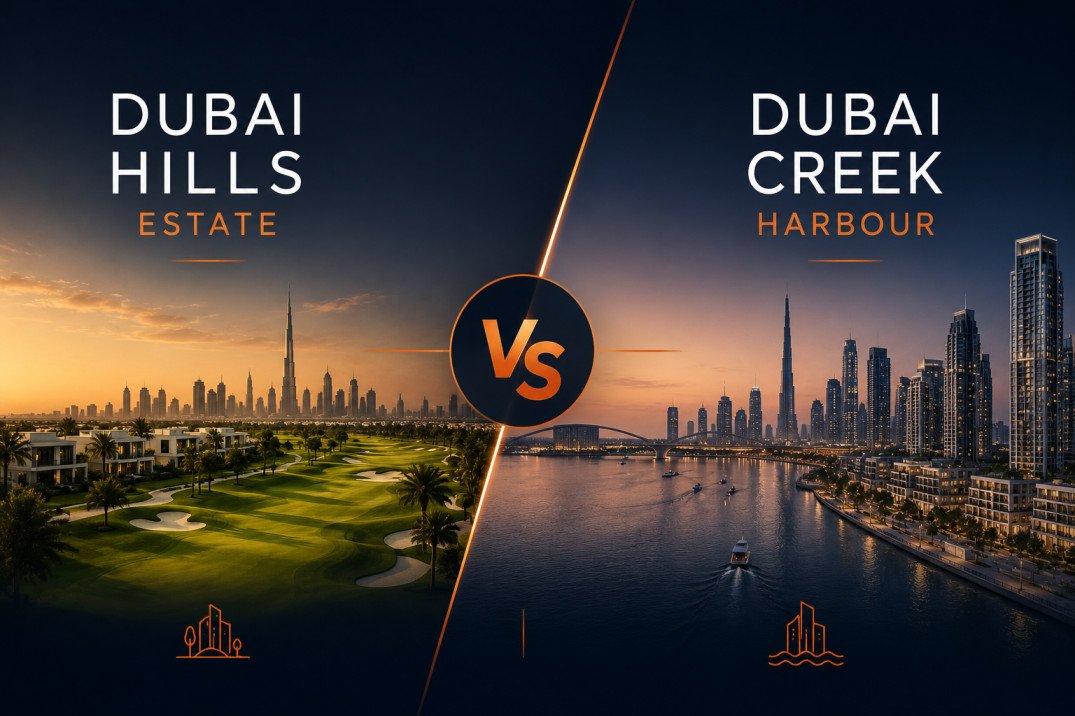
This comparison comes up often among agents working with higher-budget clients. Family buyers and seasoned investors alike want to know whether to put their capital into Dubai Hills Estate, a green and already-established master community, or Dubai Creek Harbour, Emaar’s waterfront district still taking shape along the Creek.
Both are premium Emaar-developed addresses with strong off-plan activity, but they serve different priorities. Here is how each one performs in practice, supported by current market data, along with the legal and commission details that landlords, investors, and expats should understand before buying.
Understanding the Character of Each Community
Dubai Hills Estate sits within Mohammed Bin Rashid City and is built around an 18-hole championship golf course and a large central park. It is genuinely self-contained, with Dubai Hills Mall, GEMS World Academy, and King’s College Hospital London all inside the community. Average prices across apartments, townhouses, and villas sit roughly between AED 1,500 and AED 2,400 per square foot, depending on the cluster, with capital values up significantly over the past year as villa supply has tightened.
Dubai Creek Harbour offers a different identity entirely, a waterfront, high-rise district positioned as Dubai’s next skyline, anchored by the long-planned Dubai Creek Tower and views toward Burj Khalifa and Downtown. Average prices sit around AED 2,400 to AED 2,500 per square foot, with one-bedroom apartments typically starting from AED 1.2 million off-plan, rising toward AED 1.6 million to AED 1.9 million for ready units.
Put simply: Dubai Hills Estate already feels finished. Dubai Creek Harbour is still becoming what it is meant to be.
Investment Objectives Matter More Than Location Alone
Dubai Hills Estate tends to suit buyers who want a balance of lifestyle and steady performance. Apartment yields are generally reported between 6.5% and 7.5% gross, while villa yields run lower, closer to 4.8% to 5.7%, reflecting the strong end-user demand that keeps villa prices climbing.
Dubai Creek Harbour leans more toward capital growth. Gross rental yields are typically quoted between 6% and 7.2% for one- and two-bedroom apartments, with some forecasts suggesting 8% to 12% annual price appreciation as the Blue Line Metro extension and further towers come online. As with any forward-looking forecast, it is worth treating the upper end of those numbers with healthy scepticism until delivery is confirmed.
Working with a RERA-registered agency is particularly useful here, since both communities include multiple sub-clusters, such as Park Heights and Golf Grove in Dubai Hills Estate, or The Lagoons and Creek Beach in Creek Harbour, with meaningfully different price points and tenant profiles.
Lifestyle Considerations Often Influence Long-Term Value
Families relocating to Dubai, including many expats sent here on corporate packages, are often drawn to Dubai Hills Estate specifically because of the schools, the golf course, and the sense of suburban green space inside a major city.
Dubai Creek Harbour appeals more to professionals and couples who want a waterfront promenade, cycling and walking paths, and a direct Creek Metro connection, without the price tag of Downtown Dubai or Dubai Marina.
Landlords should think carefully about which tenant profile they are building for. A three-bedroom villa in Dubai Hills Estate and a one-bedroom apartment in Creek Harbour are not competing for the same renter, and pricing strategy should reflect that.
Off-Plan Risks and Opportunities Are Not Identical
Dubai Hills Estate is the more straightforward purchase to evaluate today, since most of the masterplan’s core infrastructure is already delivered and occupancy across the community has stayed consistently high.
Dubai Creek Harbour still has phases under construction, and part of its long-term appeal is tied to the eventual completion of Dubai Creek Tower and continued retail expansion. That is not necessarily a downside. Early movers in several delivered Creek Harbour phases have already seen meaningful price growth, but it does mean checking handover timelines carefully before committing.
In both communities, the same buyer protections apply. Confirm that any off-plan project holds an active escrow account under RERA’s Law No. 8 of 2007, and verify the developer’s registration and the project’s construction progress through the Dubai REST app before transferring any deposit.
What Makes This Comparison Unique in Dubai?
Dubai Hills Estate and Dubai Creek Harbour represent two different versions of premium Dubai: one built around green space and family living, the other around water, skyline, and a more urban identity. Both happen to be Emaar developments, which gives buyers a reasonably consistent standard of build quality and delivery to compare against.
The transaction process itself does not change based on which community you choose. The DLD’s 4% registration fee applies in both cases, typically split between buyer and seller unless negotiated otherwise. Commission structures also follow the same general pattern across Dubai: buyers purchasing directly from a developer off-plan generally pay no commission, since this is covered by the developer, while resale transactions commonly involve a 2% agency fee plus VAT. These rates are market convention rather than fixed by law, and the exact figure can vary by agency, by developer relationship, and by the agreement signed, so always ask for the commission structure in writing before proceeding.
For investors comparing both communities side by side, uaebestestates can provide current listings and a clear breakdown of the fees specific to each project.
Conclusion
Dubai Hills Estate and Dubai Creek Harbour both reward patient, well-informed buyers, just in different ways. Families and steady-performance seekers will feel more at home in the established, ready-made setting of Dubai Hills Estate. Investors comfortable holding through a developing masterplan, in exchange for stronger long-term capital growth potential, are better served by Dubai Creek Harbour.
Rather than asking which address is better, it is worth asking which one matches your investment horizon, your tenant strategy, and how much uncertainty you are comfortable carrying while a masterplan finishes taking shape. In Dubai’s market, that question usually matters more than the name on the gate.
Frequently Asked Questions
Which is better for families, Dubai Hills Estate or Dubai Creek Harbour?
Dubai Hills Estate is the stronger fit for most families. It has established schools, a central park, a golf course, and a low-rise, suburban feel. Dubai Creek Harbour suits couples and professionals more than larger families, since it is built around high-rise apartment living rather than villas and townhouses.
What is the average price per square foot in each community?
Dubai Hills Estate averages roughly AED 1,500 to AED 2,400 per square foot depending on property type and cluster. Dubai Creek Harbour runs slightly higher, around AED 2,400 to AED 2,500 per square foot, reflecting its waterfront, high-rise positioning.
Is Dubai Creek Harbour a good long-term investment?
Many analysts view it positively, citing controlled supply, Emaar’s track record, and planned infrastructure such as the Blue Line Metro extension and Dubai Creek Tower.
That said, parts of the masterplan are still under construction, so returns depend on delivery timelines actually being met. Treat optimistic appreciation forecasts as a range, not a guarantee.
What rental yield can I expect from an apartment in Dubai Hills Estate?
Apartments in Dubai Hills Estate generally deliver gross rental yields between 6.5% and 7.5%, among the stronger returns for a premium, family-oriented community. Villas yield less, typically 4.8% to 5.7%, since villa prices have risen faster than rents in recent years.
Does Dubai Creek Harbour have metro access?
Yes. Creek Metro Station sits within the development itself, with Rashidiya and Emirates stations roughly 15 minutes away.
The upcoming Blue Line Metro extension is expected to improve connectivity further, which is one reason some investors expect continued price support in the area.