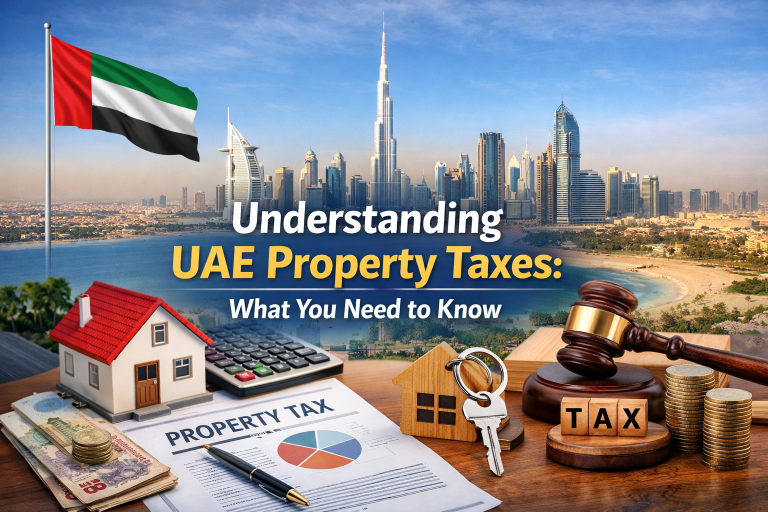
The real estate market in the United Arab Emirates has always attracted investors from all over the world. Cities like Dubai and Abu Dhabi offer modern infrastructure, strong rental yields, and a tax friendly environment. However, many buyers still ask a common question. What exactly are property taxes in the UAE, and how do they work?
This guide explains everything in simple English. It gives real examples, useful facts, and practical advice so you can make better property decisions.
What Are UAE Property Taxes
The UAE is often called a tax free country for property investors. This is mostly true. There is no annual property tax like in many other countries. There is also no capital gains tax on property sales. However, this does not mean there are zero costs. Instead of traditional taxes, the UAE has fees and charges linked to property transactions and ownership.
For example, when you buy a property in Dubai, you must pay a transfer fee to the Dubai Land Department. This fee works like a one time tax during purchase. Buyers also pay registration charges, agent fees, and service charges. A real estate advisor once said, “The UAE is not tax free, it is tax efficient. Investors must understand the difference.” This is a very important point for beginners.
Why UAE Has No Annual Property Tax
The UAE government earns revenue in different ways. Oil income, tourism, business licensing, and VAT all support the economy. Because of this, the country does not rely on annual property taxes like the US or UK. This policy helps attract foreign investors. It makes property ownership more affordable and predictable.
For example, in many countries, property owners must pay yearly taxes based on property value. In the UAE, once you buy the property, you only pay maintenance and service related charges. A client from London once shared his experience. He said that in the UK, he paid thousands of pounds every year in property tax. After buying in Dubai, he was surprised that there was no yearly tax at all.
Key Property Related Fees in UAE
Even without traditional taxes, buyers must understand the main fees. These costs can affect your total investment.
Here is a simple table explaining the major charges:
| Fee Type | Description | Approximate Cost |
| Transfer Fee | Paid to land department | 4 percent of property value |
| Registration Fee | Admin cost for property registration | AED 2,000 to AED 4,000 |
| Real Estate Agent Fee | Paid to broker | 2 percent of property price |
| Mortgage Fee | If financing property | Around 0.25 percent |
| Service Charges | Annual maintenance cost | AED 10 to AED 30 per sq ft |
These fees are important when calculating your total budget.
Understanding Service Charges in UAE
Service charges are the most important ongoing cost for property owners. These charges are paid every year to maintain the building or community. They cover cleaning, security, landscaping, repairs, and shared facilities like gyms and pools.
For example, a luxury apartment in Downtown Dubai may have higher service charges compared to a simple apartment in a suburban area. A property manager once explained it clearly. He said, “Buyers focus too much on price and forget service charges. But these charges affect long term returns.” This is why smart investors always check service fees before buying.
VAT and Its Role in Property
The UAE introduced VAT in 2018. It is set at 5 percent. However, VAT does not apply equally to all property types. Residential properties are usually exempt from VAT after the first sale. This means if you buy a ready home from an owner, you do not pay VAT.
Commercial properties are different. Offices, shops, and warehouses are subject to VAT. Investors must include this cost in their calculations.
Here is a simple comparison:
| Property Type | VAT Applicable |
| New Residential Property | 5 percent |
| Resale Residential Property | No VAT |
| Commercial Property | 5 percent |
Understanding VAT helps avoid unexpected costs.
Rental Income and Taxes
One of the biggest advantages of UAE property investment is rental income. The good news is that rental income is not taxed. This means landlords can keep their full earnings without deductions from the government.
For example, if you earn AED 100,000 per year from rent, you keep the full amount. This makes UAE one of the most attractive rental markets globally. However, landlords still need to consider service charges and maintenance costs. A Dubai based investor once shared, “The best part is not just earning rent, but keeping it fully. That is rare in global markets.”
Capital Gains and Property Sales
Another major benefit is the absence of capital gains tax. When you sell a property in the UAE, you do not pay tax on the profit.
For example, if you buy a property for AED 1 million and sell it for AED 1.5 million, the AED 500,000 profit is yours. This is a huge advantage compared to countries where capital gains tax can be very high. However, you still need to pay a transfer fee when selling. This cost is usually shared between buyer and seller, depending on the agreement.
Case Study Real Investor Experience
Let’s look at a real example to understand better. Ahmed, an investor from Pakistan, bought a one bedroom apartment in Dubai Marina for AED 900,000. His total upfront costs included transfer fee, agent commission, and registration. His yearly service charges were around AED 12,000. He rented the apartment for AED 75,000 per year.
After deducting service charges, his net income was AED 63,000. Since there was no income tax, he kept all profits. After three years, he sold the property for AED 1.1 million. He made a profit without paying capital gains tax. Ahmed said, “I did not expect the process to be so simple. The transparency and low tax structure made a big difference.”
Common Mistakes Buyers Make
Many new investors misunderstand the UAE tax system. They assume there are no costs at all. Some buyers ignore service charges and later face financial pressure. Others forget to include transfer fees in their budget.
Here are common mistakes explained in simple terms:
| Mistake | Impact |
| Ignoring service charges | Lower profit |
| Not budgeting for fees | Financial stress |
| Misunderstanding VAT | Unexpected costs |
| Overestimating rental income | Poor investment returns |
Avoiding these mistakes can improve your investment results.
How to Plan Your Property Investment
Planning is very important when investing in UAE real estate. You must calculate all costs before buying. Start by checking property price, location, and expected rental income. Then add transfer fee, agent fee, and service charges.
Compare different properties and choose the one with better returns. A property consultant once said, “Good investment is not about buying cheap. It is about understanding the numbers.” This advice can help you make smarter decisions.
Sources and References
This article is based on data and insights from Dubai Land Department, UAE Federal Tax Authority, real estate brokers, and investor case studies. Market practices and fee structures are taken from current UAE real estate trends and official guidelines.
FAQs About UAE Property Taxes
1. Is there property tax in UAE?
There is no annual property tax in the UAE. However, buyers must pay one time fees like transfer and registration charges.
2. Do I pay tax on rental income?
No, rental income is not taxed in the UAE. Landlords keep their full earnings.
3. What is the Dubai property transfer fee?
The transfer fee is usually 4 percent of the property value. It is paid to the land department.
4. Is VAT applied on all properties?
No, VAT applies mainly to commercial properties and first sale of new residential units.
5. Are service charges mandatory?
Yes, all property owners must pay service charges for maintenance and building services.
6. Do I pay tax when selling property?
No, there is no capital gains tax. You keep your full profit after sale.
7. Can foreigners buy property in UAE?
Yes, foreigners can buy property in designated freehold areas in cities like Dubai.
8. What is the biggest cost after buying property?
The biggest ongoing cost is service charges, which vary based on property type and location.
Final Thoughts
Understanding UAE property taxes is simple once you know the system. The country does not follow traditional tax models. Instead, it offers a low tax and investor friendly environment.
This is why many global investors choose UAE real estate. With no annual tax, no income tax, and no capital gains tax, the market provides strong opportunities.
However, smart investors always study fees, service charges, and VAT rules before buying. With proper planning, UAE property can be a profitable and stress free investment.
About the Author